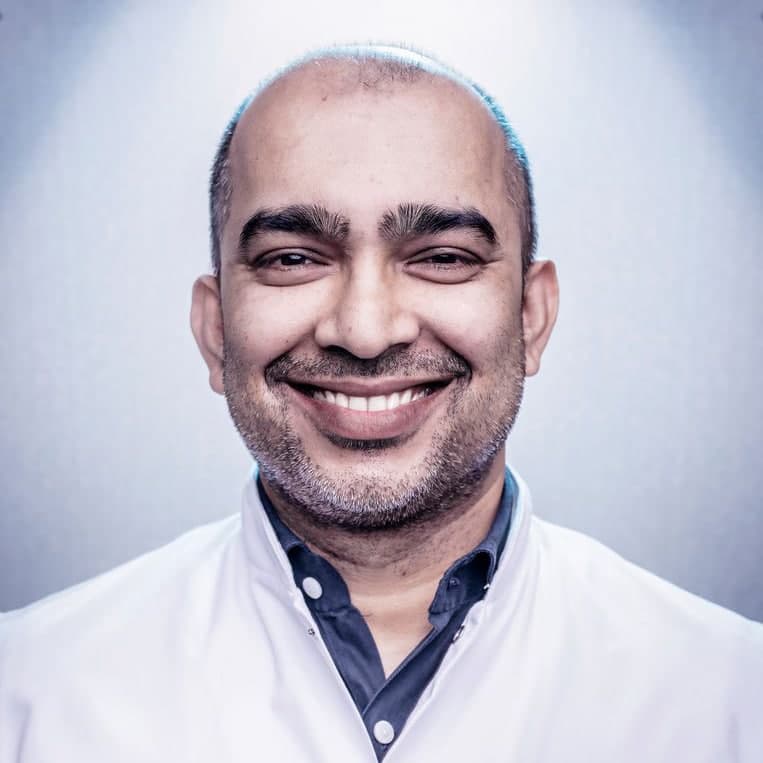
Plastic surgeon Kalam Ahmed of Blooming was featured in the Dutch newspaper De Parool, where he shared his views on the evolving landscape of cosmetic surgery in the Netherlands. He discussed trends, the role of social media in shaping beauty ideals, and the importance of honest consultations. Dr. Ahmed emphasises that surgery should always serve the individual's wellbeing and that a careful, personal approach is the foundation of responsible aesthetic medicine.
Kalam Ahmed (48) has become the coolest doctor: plastic surgeon. At his own clinic Blooming he is fully booked for cosmetic procedures, and as soon as possible he will go on a burns surgery mission to his native country Bangladesh.
Two years ago, when Kalam Ahmed was on a mission in Bangladesh, a boy came to him with a stump where his hand used to be. As a young child he had burned his hand. "That happens very often in Bangladesh: life, especially in rural areas, revolves around open fire," says Ahmed (48). "Children play around it. One moment of inattention and you have a scalding pot of soup or dahl poured over you. If you do not treat those burns, you get contractures. Scar tissue does not grow with the body the way skin does, which means the limbs of children with burns become deformed as they grow."
"That had happened to this boy too. I took hold of his stump and felt all sorts of things moving. His hand had contracted, the skin had grown over it and the scar tissue had wrapped around it like a glove. But all the structures were still there. We carefully opened up that hand. It is not yet ideal, but perhaps he will be able to write again."
Since 2014 Ahmed and his team have gone on a mission each year. He also hopes to see again the woman whose sari caught fire while cooking. Her chest, neck and face had been burned years earlier, and the scar tissue had pulled so tight that her lower lip had become fused to her sternum. "We cut through the skin at the throat, even released some muscles because those too had shortened, and then she could finally look straight ahead again. But this woman had been abandoned by her husband and by her children."
If you are burned in Bangladesh, your life is over."For an adult woman, yes. Such a burn is seen in certain cultures as a punishment. But also girls born with a cleft lip that is not corrected have no future. Nobody wants to marry you. Such a procedure is therefore a life-changing moment for them."
How was it for you to be there?"I notice that it moves me. I was born there myself. Until I was eight I lived in Feni, between Dhaka and the port city in the south. We had no stone walls, no running water. We also cooked on open fire. Those little fires that children fell into — I sat around them too. I can picture it so clearly."
In 1980 you arrived in Amsterdam."That was a total shock. I had never seen a white person, had never flown. We had a flat in Gerenstein, in the Bijlmer, on the ninth floor. The Bijlmermeer was car-free. It was like a fairy tale. That first winter I saw snow for the first time. I thought it was milk, or a flood. But now it was white. So wonderful."
Did you go back often?"Every year. Thanks to my father's job we could fly cheaply. My mother sewed doll's clothes for Volendam tourist shops — she perhaps earned a thousand guilders a month from that. My parents had financial difficulties because they had to support the family. I never played football in a club — I played in the street. My father filled a large pot with guilders and rijksdaalders. That money was for the whole month and for my sisters too, but it did give a sense of freedom."
Were you poorer than your classmates?"It did not feel that way. But there were children who occasionally got a new bicycle, or who went on holiday to a house with a swimming pool in the Canary Islands."
And now you have a swimming pool in your own home."It did not happen that consciously. My father always wanted me to become a doctor. When I had just been born, he was in hospital with a bowel perforation. The doctor who took blood from him said my father had two hours to live if he did not operate. This doctor is a hero who saved his life. He then decided: when my son grows up, he too must become a doctor and save people's lives."
How did you end up in plastic surgery?"I had first decided: if I become a doctor, I will become the coolest doctor there is. Cardiac surgeon — that is the king of doctors. But in the end I found that specialism too one-sided. Plastic surgery was more creative. A Bangladeshi doctor took me under his wing. Thanks to his recommendation I was ultimately accepted at the AMC. I had also sent many letters to other clinics and never heard back. At that point I had started to doubt myself."
Did you ever think that had something to do with your background?"My surname does not work in my favour. But it is also easy to attribute things to racism. There were also genuinely very few training places. At the time I looked primarily at myself and thought: perhaps I am not ready yet. I then did more research and wrote articles, and ultimately I was selected. Perhaps I was lucky, and I will certainly be treated differently at times, but I try not to dwell on it too much. That is all negative energy. I do know that once my wife was allowed to choose a new BMW for the company she is a partner at. We arrived at the dealer in Amsterdam and they immediately sent us to the first floor, where the second-hand cars are. So we just left. In the end we bought a BMW here in Amstelveen, and then a few more. They lost a good customer in Amsterdam."
Since 2009 Ahmed has worked as a plastic surgeon at Spaarne Gasthuis, the burns centre in Beverwijk and the private clinic Blooming in Haarlem. Blooming, where he has been general director for two years, has adopted the plastic surgery mission of Interplast.
With which work do you make the greatest difference now?"I think both can make a difference. In reconstructive plastic surgery it is clear: you give someone back something they no longer have. If you can give a woman who lost her breast to cancer a new breast and make something truly beautiful of it, that is a tangible difference. But a breast lift can also apply. For women who feel less comfortable in their body after years of breastfeeding, you can also truly make a difference. If you can help a young woman with virtually no breast development and you do it well, that can genuinely change her life."
It does involve cutting into a healthy body."Certainly, but for an improvement. If someone has lost a great deal of weight, they often have a lot of excess skin. Then you are cutting into a healthy body, but that person may be greatly troubled by that excess skin."
Do you perform labiaplasty procedures?"Not many. Most women who come for that prefer a female plastic surgeon."
And hymenoplasty?"No. I almost never receive the request, and I find it an odd procedure. I would refer someone who asks for this elsewhere."
In Islam, cosmetic surgery is a sensitive issue. The body belongs to God and must not be altered."Is that so? Apparently I am not a good Muslim, not knowing that. Religion is meant to guide us as human beings in the right direction. If someone is unhappy in their body, a cosmetic procedure is sometimes a solution. I do not see how that can be forbidden. You are wearing earrings — that could also be called mutilation. In Bangladesh virtually all Muslim women have a hole somewhere with a piece of jewellery through it. Is that also forbidden?"
What do people ask you at birthday parties?"They often want to know who I have put under the knife. Of course I say nothing about that. Or they want to know what on earth Demi Moore has had done. And often people associate me with Botox and fillers, but that is something plastic surgeons really only do on the side."
What is the difference between the two?"Botox is a neurotoxin that locally paralyses a muscle or a gland. A filler fills in a hollow. You have a small under-eye bag — that is a hollow in the tear trough. You could put a little filler in there and it will look somewhat fresher."
I cannot get rid of those bags by sleeping more."Sleeping upright rather than flat does help. Permanent fillers are banned — they caused too many complications. A temporary filler softens things somewhat. If you do not like it, it can easily be dissolved. When patients have had a facelift, people often say: 'Goodness, you look great — have you been to the hairdresser?' People do not notice, because the person still looks like themselves — but ten years younger."
Your wife just mentioned that you said to her: you could do with some Botox."I once suggested it at a time when she was speaking with a lot of facial expression. Botox, when correctly dosed, is a safe treatment."
Was she not offended?"Not at all. I could say it to her because I know she cares very much about her appearance. But I also speak frankly with my patients. I ask whether I may, and virtually everyone always says yes."
Is there greater demand for cosmetic surgery now?"We are fully booked for the coming weeks. In terms of business, coronavirus has been very good for us. I think the threshold is now lower because people see themselves on screens more often. And after a procedure you are always out of action for a few weeks, which is now also easier to arrange."
What does your father think of you having become a plastic surgeon?"He still thinks I am saving people's lives. And in a certain sense that is true. He is very proud, including of the fact that I go back to Bangladesh so often. When I am in Feni, I go to the tea house at the market. Then all sorts of people gather around you and ask questions. They always ask what I earn."
What do you say?"Nothing. In the Netherlands that question is not done. I have become that Dutch."
Do you never feel guilty?"You feel guilty when you have taken something from someone. I try to give something back in every way I can. If my family needs money for medical care or education, I send it. My nephew runs a sanitary pad factory for poor people in Bangladesh. And during Ramadan my father ensures that all the people in the region who are in need have sufficient provisions. According to my faith you should donate a few per cent of your income, but it also makes me happy."
Do you never think: if I had stayed in Bangladesh, I would have needed that help myself?"If I had bought Bitcoin, I would have been a billionaire. It is not karma. I do sometimes think: if I did not go to Bangladesh for those two weeks a year but simply worked in the Netherlands and donated that earned money, they could hire many more local doctors. Perhaps that would be better. But in those two weeks our team operates on more than two hundred patients. That also simply gives an enormous sense of satisfaction."
Kalam Ahmed
15 July 1972, Feni, Bangladesh. 1980 Moved to the Netherlands. 1980-1986 Primary school De Bijlmerhorst. 1986-1992 Pre-university education, Augustinus College. 1993-2000 Medical degree, VUMC. 2000-2009 Residencies in plastic surgery (Slotervaartziekenhuis, OLVG, Rode Kruis Beverwijk, AMC/AvL/RKZ). 2009-present Plastic surgeon, Spaarne Gasthuis and Blooming in Haarlem. 2014-present Annual mission with Interplast. 2019-present General director, Blooming.
Kalam Ahmed lives with his wife and three children in Amstelveen.
Source: parool.nl