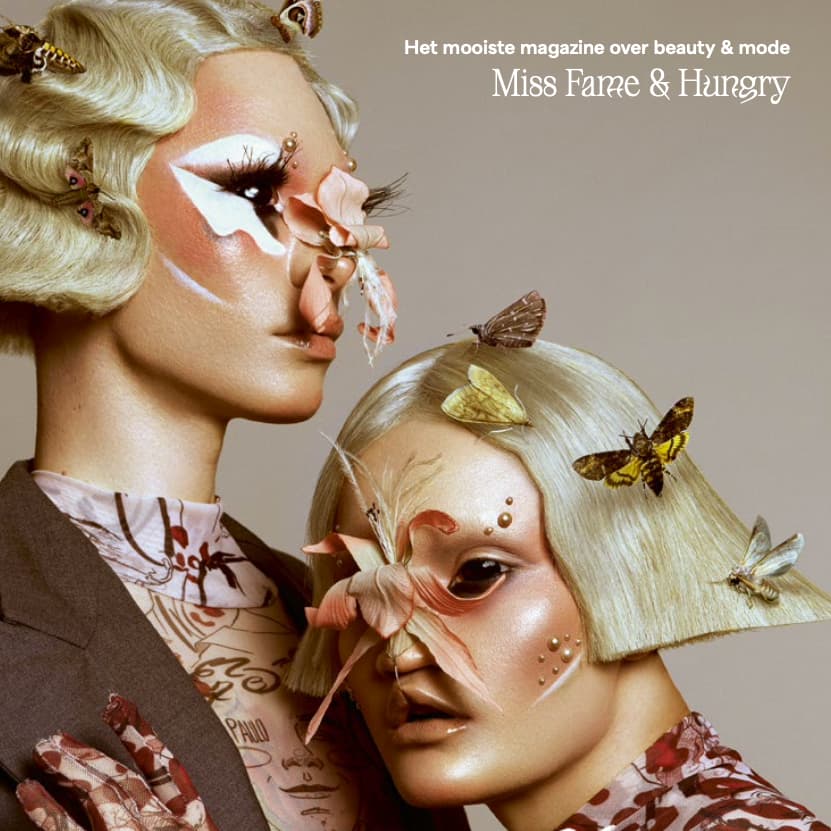
In the latest edition of the beautiful
MIRROR MIRROR Magazine
plastic surgeon Wouter van der Pot answers the questions of editor-in-chief Georgette Koning.
"If you have no eye for aesthetics, you have a real problem in this field."
Do you remember your first procedure? "Not exactly, but I do remember my first eyelid correction. Exciting, because during such an operation the patient — who I still have — is awake. I performed the operation alone and that was certainly nerve-racking."
What do you find most fascinating about your profession? "That you get a very verifiable, measurable result. What I create is immediately visible to patients in the mirror — and to those around them. As an orthopaedic surgeon you make bones that need to function well, so you measure a certain degree of success there too. But in our field it is immediately visible and the patient has an immediate opinion about it.
"People deliberate for a long time about a procedure, and once they decide to go ahead they seriously start looking for someone they trust to cut into their healthy body. There is often a great deal of doubt. With breast augmentations, for example, they are afraid it will turn into that stereotypical enlargement with clearly visible implants. If someone trusts me and I create something that satisfies them, that is very rewarding. That is what fascinates me about my profession."
Do you notice, as a plastic surgeon, that injectables are the new scalpel — because people are postponing surgery for longer? "I perform more facelifts and eyelid corrections than ever. It is a misconception to think that injectables replace surgery. If someone truly has an excess of skin, that cannot be resolved with fillers. So much volume would need to be injected into a face that the result becomes the classic pillow face — a puffed-up look. That looks very strange. Those stereotypical 'plastic surgery gone wrong' patients have gone too far with fillers and injectables. That is not caused by plastic surgery."
Do injectables make the step towards surgery easier for young people? "Young people with a small beginning under-eye bag I would not quickly operate on. But something can be done with a filler. In that sense you can postpone surgery at an early stage. But it is absolutely not a replacement for surgery."
Injectables are a relatively new phenomenon. Never before have people had so many treatments on their appearance. What does this say, in your view, about humanity and the times? "A complicated question. Previously, especially young women, looked up to a Cindy Crawford or Kim Basinger who appeared on magazine covers. 'Wow, what beautiful women,' they thought. 'But a different league.' Now young women compare themselves to Instagram women — who do not even have to be famous like the Kylie Jenners, but people they vaguely know who look beautiful through filters. Through digitalisation a role model reaches you via many channels, and with it perhaps a certain beauty ideal.
"It is said that conforming to a beauty ideal places great pressure on young people. Are people becoming more vain? We have always been vain. Perhaps people set the bar higher for themselves than before."
What are the positive sides to the normalisation of injectable use? And what are the negative sides? "Injectables are nowadays always temporary — permanent fillers have been completely phased out and that is very positive. The risks are quite limited, as long as you go to a good doctor who knows what to do and when to stop. As a doctor you should never go along with extreme requests.
"Doctors must be aware that young people are impressionable and may be pursuing a beauty ideal that is not entirely realistic. The negative side is that what someone does in a photo with a filter, you can do to a face with a filler. You have to assess case by case how realistic the wish is. Does this person suffer from body dysmorphic disorder — imagined ugliness?"
On your Instagram @woutervanderpot there are before and after photos of procedures. Does this mean there is no longer a taboo around plastic surgery? "I consider my Instagram as an online portfolio where you can see what is possible. I have a passion for my work and many clients give their permission to appear online with their full face. I find that admirable and I appreciate it enormously. To some degree there is still a taboo around plastic surgery, although it is becoming increasingly normal. In the past people were judged for it: 'Oh, have you had something done?'
"My facelift clients — often women in their fifties — are usually very ordinary ladies who notice skin laxity after the menopause and are looking for a solution. They look older than they feel, have an operation, and absolutely do not want the whole world to know. Generally speaking, women have a facelift for themselves and not, as in the past, as a status symbol."
Do you consider yourself an artist? "That is a big word. But it is absolutely an artistic profession. If you have no eye for aesthetics, you have a real problem in this field. If you are not dexterous and cannot make a beautiful drawing, or sculpt, or have no affinity with design, then I think it would be difficult to hold your own in plastic surgery at a high level. Because as a doctor you ultimately have to create something that looks beautiful. Above all you have to try to meet the patient's expectations, ultimately within certain limits, because there are many frameworks within which we as a whole consider things beautiful or not. In a certain sense you could say that I have an artistic profession and I am an artist, although it sounds a bit odd."
What beauty from art history appeals to you? "I am more drawn to hyperrealism than abstract art. So I find something most beautiful when it looks very real and is painted beautifully. I am less drawn to modern art."
Have you had a procedure done yourself, or performed treatments on close friends or family? "No. Would I have something done? Perhaps. If there were something that bothered me, why not? I have never done anything to my wife — she is very beautiful. With friends, certainly. Lots of eyelid corrections. With female friends: a little Botox, a little filler.
"If you have a personal bond with someone you have to be careful. Then I would look for a colleague I trust completely. But I have operated on many parents of close friends — facelifts. In the past I found that more nerve-racking; now it is easier, which is entirely down to self-confidence."
How will plastic surgery develop in the future?
"In my own practice I notice it is only getting busier. In the future I think we will want a natural appearance rather than an artificial one with large round breast implants.
We are increasingly working with the patient's own fatty tissue and gaining ever more insight into the role of fat in the ageing process. Where the focus used to be primarily on wrinkles and tightening the skin, nowadays we are increasingly concerned with restoring volume to the face. Another trend is hybrid treatments — for example, combining fatty tissue with implants in the breasts. That fat comes from a place where the patient does not want it. There is a great deal that can be done with combination treatments. Natural and healthy will be very central going forward."
https://www.mirror-mirror.nl