
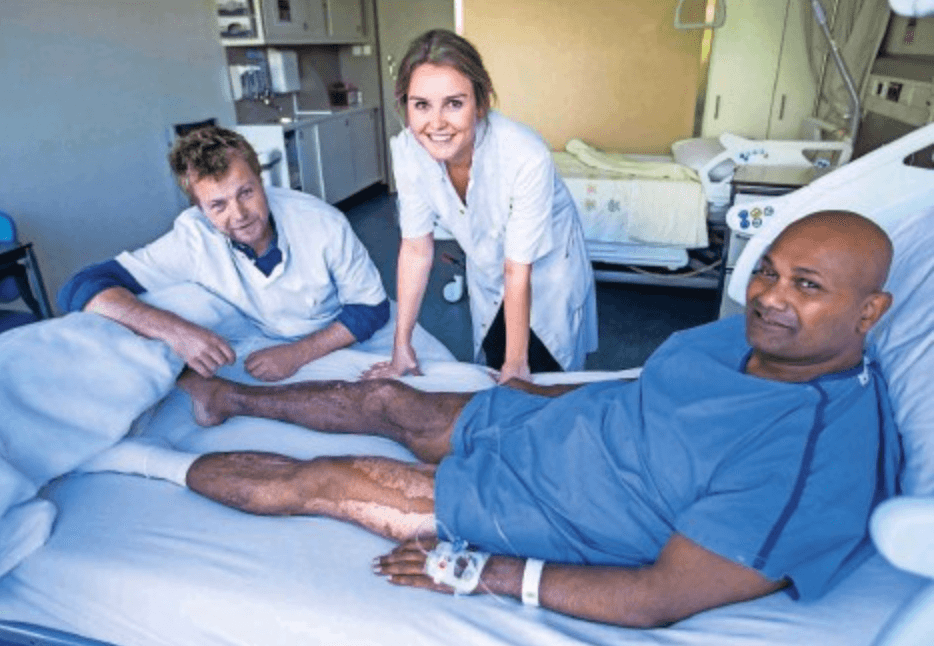
A burns professor affiliated with Blooming Plastische Chirurgie made headlines in De Telegraaf by presenting an ambitious global plan to improve the treatment and prevention of burn injuries worldwide. The article highlighted the important role that plastic and reconstructive surgeons play beyond aesthetics, including life-saving and life-restoring work for trauma patients. Blooming is proud to be home to surgeons who are leaders not only in their clinical practice, but also in advancing the field on an international stage.
The scars of burns patients around the world are healing better thanks to an assessment method developed by a Dutch plastic surgeon.
Professor Paul van Zuijlen (47), special professor of burns medicine at the Vrije Universiteit in Amsterdam, developed guidelines over ten years ago that allow the severity of scars following a fire or liquid burn to be estimated more accurately. Now, ten years later, Van Zuijlen scars scale is also being used in the US and Canada, Australia, China, the Philippines, Japan, Sweden and South Korea. In Great Britain, the Dutch guideline has recently even become the standard for analysing scars. In this method, both the patient and the doctor provide scores on aspects including pain, redness, itching and swelling of scars. Scars have become an increasingly significant challenge in the ever-improving treatment of burns, Van Zuijlen notes. Forty years ago, most patients died after a severe burn, usually from accompanying infections. Now, with the use of antibiotics, the treatment of even very large burns is so effective that the vast majority of patients survive. But large skin surfaces that have healed often leave behind large scars. And that is where the challenge lies now. Large, raised scars are experienced by patients not only as disfiguring - they also often restrict freedom of movement. If a doctor better understands the patient scars, and this is possible with this method, then he is able to provide better treatment, says Professor Van Zuijlen. It suddenly occurred to me that as doctors we should not accept that the patient recovers from their burn, but then suffers from the grief of their scars that literally disfigure their life. The Beverwijk burns specialist wrote down some recommendations, which are now serving as guidelines in an increasing number of countries for better scars following burns, acid attacks, accidents and now also the consequences of flesh-eating bacteria. Last Friday, Paul van Zuijlen spoke at the congress of the British Burns Association in London, where the starting gun was fired for a further improvement of Van Zuijlen POSAS method (Patient and Observer Scar Assessment Scale).