
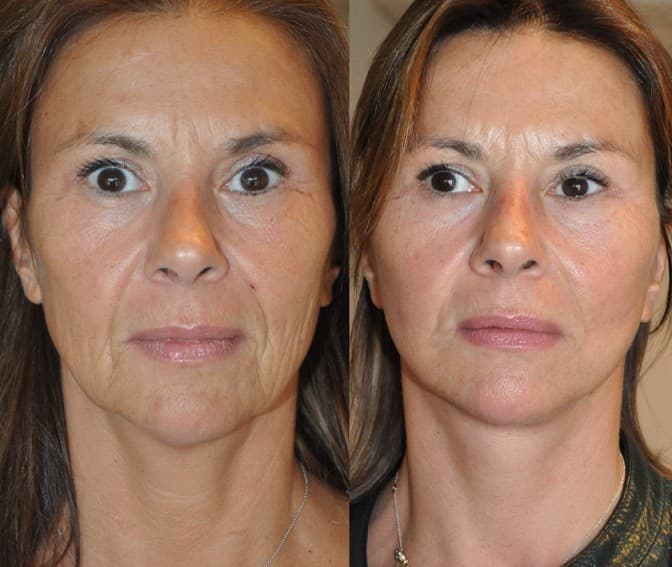
Facelift techniques have evolved significantly, and the procedures available in 2015 represent a major leap forward from earlier approaches. Modern facelifts focus on repositioning deep facial structures and restoring volume for natural, long-lasting results. In this article, our plastic surgeons explain the key advances in facelift surgery, what patients can realistically expect from today's techniques, and how to determine whether a facelift is the right choice. If you are considering facial rejuvenation, this in-depth overview will help you make an informed decision.
Many people who are getting a little older and are developing some laxity in the skin of the neck, cheeks, and jawline can demonstrate precisely in the mirror how they would look a good deal younger. They place their fingers at the angle of the jaw and push the skin upwards, causing the skin of the neck to tighten, the angle between the throat and the underside of the chin to become sharper, and the jawline to become more defined. "Look, like this, doctor — that's how I want it." Simple enough! The earliest facelifts began this way: a small amount of skin was removed around the ear, causing the skin to tighten and a more youthful appearance to be achieved. This remained the approach from 1900 until 1970, until in 1968 Tord Skoog discovered that it was better to lift the deeper, more robust fascial layer.
He observed that the effect of simply removing skin does not last long. Skin has the property of creating additional skin wherever it is placed under tension. When we as plastic surgeons need to reconstruct a breast for a woman whose breast has been removed, we make use of this property by placing what is known as a "tissue expander" beneath the skin. This is a small balloon that can be inflated through the skin, allowing us to expand it a little further each week. In this way, we can create as much new skin as we need in order to ultimately place a silicone implant. The same principle is why people who gain a great deal of weight in a short time end up with excess skin once they lose it again. In short: by simply tightening the skin in a facelift, the effect will not be long-lasting.
Once this was understood, surgeons began looking deeper. All the facial muscles are covered by a layer of fascia or aponeurosis: the Superficial Musculo Aponeurotic System, or SMAS, which was first described under that name in 1974. By tightening the SMAS, it is indeed possible to achieve a long-lasting good result. The procedure has therefore become considerably more extensive; in order to tighten the SMAS properly, a larger portion of the cheek needs to be undermined. Ultimately a piece of skin is also removed, but the tension rests on the deeper, more robust layer.
The direction in which the skin is ultimately moved has also changed over the years. The classic old-fashioned American facelift was characterised by the skin being pulled tightly and horizontally backwards, which produced an unnatural appearance. This is still the stereotypical image many people have of a facelift — an unnaturally taut face. Fortunately, that era is well behind us. Nowadays, the direction and degree of tension are far more nuanced, and the results are consequently much more natural.
When performing a facelift, knowledge of anatomy is essential. If the dissection plane is too deep, there is a risk of damaging the facial nerves, with all the consequences that entails. If it is too superficial, the skin flap may be made too thin and could fail to survive. For this reason, it is a procedure that is primarily performed by trained plastic surgeons with a particular focus on cosmetic surgery.
The future of facelifts lies primarily in the complementary therapies with which a facelift is now routinely combined. In recent years, it has become increasingly clear that ageing is not simply a matter of skin displacement or sagging, but also involves the loss and even disappearance of fat and volume in the face. Restoring volume has long been possible using hyaluronic acid fillers, but in recent years the use of the patient's own fat tissue to fill the face (lipofilling) has grown considerably. In addition, improving skin quality through peels or lasers is an enormous complement to a facelift. In this way, you are not only repositioning the (ageing) skin, but also restoring a much more youthful appearance to it. The future, with all the developments in stem cell therapies, is therefore very promising.
Would you like more information about facelifts at Kliniek Blooming? Please feel free to contact us.