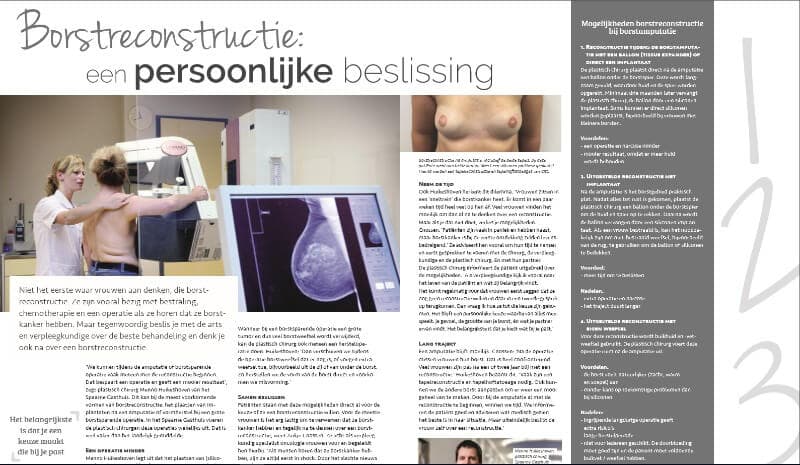
Dr. Menno Huikeshoven was featured in ForYou magazine, where he explained the process and impact of breast reconstruction surgery. Breast reconstruction after mastectomy is one of the most meaningful procedures in plastic surgery, helping women restore their sense of self. Dr. Huikeshoven discusses different reconstruction techniques, the importance of timing, and what patients can realistically expect during recovery. His empathetic approach and technical expertise make him a trusted specialist for women navigating this life-changing journey.
A breast reconstruction is a personal decision - and one that is thrust upon you. When you receive a breast cancer diagnosis, a breast reconstruction may well be the last thing on your mind. Yet it is a decision you must consider straight away, as reconstruction can often be started during or immediately after a breast-conserving operation.
When women receive a breast cancer diagnosis, they are primarily focused on chemotherapy, radiotherapy and surgery. A breast reconstruction is not the first thing they think about. Nowadays, together with the doctor and nurse, you can decide on the best treatment for your situation and also consider a breast reconstruction. It is important that you make a choice that suits you. During the amputation or a breast-conserving operation, it is possible to begin reconstruction immediately. This often yields a better result and also saves an operation, says plastic surgeon Menno Huikeshoven, who works at Het Spaarne Gasthuis and Blooming Plastische Chirurgie. This can be performed for the most common forms of breast reconstruction, such as shape restoration following a major breast-conserving operation and when placing implants after an amputation. Dr Menno Huikeshoven explains: The placement of (silicone) implants in one or two stages is possible. "Often during the amputation we place a balloon beneath the chest muscle, which we use to stretch the muscle and skin. About four months later, the balloon can be removed and a permanent implant placed. It also happens that we place a permanent implant directly, for example in women with smaller breasts."
Corrective surgery
When a large tumour - and therefore a large amount of breast tissue - is removed during a breast-conserving operation, the plastic surgeon can also perform a corrective operation at the same time. Menno Huikeshoven: "During the operation we shift remaining breast tissue, or add extra tissue, for example from the side or the underside of the breast. In this way we restore the shape of the breast immediately and prevent deformity." Patients are immediately faced with the choice of whether they want a breast reconstruction. For most women, it is very difficult to come to terms with having breast cancer while simultaneously thinking about a breast reconstruction, as oncology nurse specialist Aukje Cnossen knows. She informs and guides women through this process. When people hear they have cancer, they are always initially in shock. The bad news brings chaos to their lives. They want to survive and have to think about a reconstruction. By guiding them, they can better choose what suits them. Aukje Cnossen often asks women what their breasts mean to them. This can be very different for everyone and is not age-related.
Dr Menno Huikeshoven recognises this dilemma that women go through. They find themselves on a train called breast cancer and an enormous amount is thrown at them within a few weeks. As a result, many women find it difficult to think about reconstruction already. Yet this is important, as otherwise they lose options. Cnossen adds: Patients are often in a panic and feel rushed, but breast cancer is rarely life-threatening at first discovery. She therefore advises women to take their time and speak with the surgeon, the nurse and the plastic surgeon - and of course their partner. The plastic surgeon can inform the patient extensively about the options and how this process works.
As a nurse, Cnossen looks primarily at the patients lives and what is important to them. Women regularly say they do not want a breast reconstruction and then change their mind during the second consultation. They are asked how they came to that decision. This ultimately remains a personal choice in which many factors play a role: your own feelings, those of your partner, and the size of your breast. It is important that you choose what suits you. An amputation remains difficult, and after the operation women miss their breast. This can be very confronting - we also see that many women are only truly satisfied with their reconstruction after a year or two. Dr Menno Huikeshoven also recognises and confirms this. A nipple reconstruction and an areola tattoo are often also necessary. Or the other breast may also need to be adjusted to create a matched appearance. We gain time by beginning the reconstruction at the time of the amputation. The woman herself decides about a reconstruction, but we advise and inform her about what is medically best in her situation.
View the full article here.